Food Contact Materials Legislation & Compliance Guidance
Food packaging companies, food processing equipment firms, and the provision of materials used in food packaging have to act under stringent regulations enacted by the European Community in terms of the substances that can come into contact with food. These regulations are provided with the view of assuring that materials do not contain toxic substances that might impact food safety or the health of the consumers.
Food Contact Legislation is an important piece of information to understand when a manufacturer, importer, or retailer is conducting operations within the European market. Compliance heavily involves the evaluation of materials, supply chain, testing processes, and regulatory documentation. In the absence of an organized strategy, companies can be hit by product recalls, fines by the government, or even entry barriers.
In Alfred Olthof Consulting, companies are advised on specific issues related to the complex regulation of food contact materials. This is aimed at compliance as well as long-term assurance that its packaging materials and parts are in accordance with European safety regulations.
What Are Food Contact Materials?
Food contact materials are any product or material that can come into contact with food in the course of manufacturing, processing, storage, packaging, or consumption. Such materials may include plastic wrapping and metal containers, or even coatings and adhesives, as well as processing equipment.
Since they are in direct contact with food, the regulatory authorities are very strict in rules concerning their composition and performance. The manufacturers should prove that their products do not transfer dangerous substances to food in a way that is unacceptable.
Typical types of food contact materials are:
- Food containers and packaging are made of plastic.
- Metal cans and lids
- Packaging made of paper and cardboard.
- Inks, glues, and finishes, printing.
- Machinery and utensils of food processing.
To see to it that these materials are in accordance with the regulatory requirement, technical knowledge and regulatory knowledge are needed.
European Regulatory Framework for Food Contact Materials
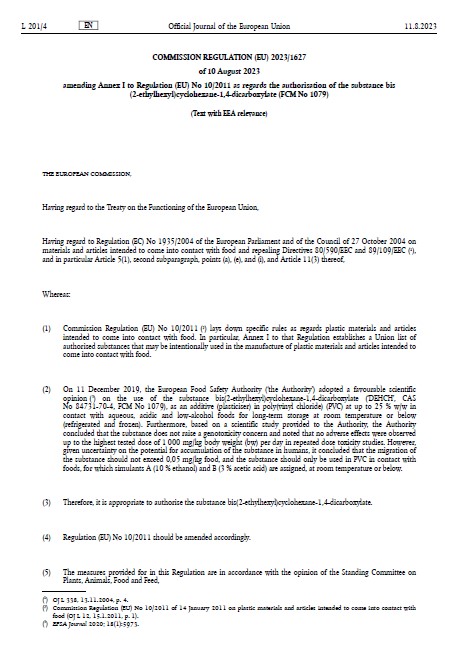
The European Union has come up with an elaborate legal framework that governs food contact materials. The regulation EU-1935-2004 Food Contact Materials is the most significant one that provides the general safety principles of materials that are supposed to come in contact with food.
This provision states that materials should not:
- Endanger human health
- Modify the food composition.
- Modify the flavor or smell of food.
Besides the framework regulation, the manufacturers should also have in mind such supporting legislation as the EU-2023-2006 Legislation, which provides the good manufacturing practice requirements of the food contact materials.
Collectively, these measures provide a guarantee to firms that they apply appropriate manufacturing oversight, documentation, and checks on the safety of the materials utilized in the use of food.
Compliance Requirements for Food Contact Materials
Compliance with European standards takes a series of processes, which may not be a mere product test. Business firms should put in place mechanisms that indicate continual adherence to legal standards.
The important compliance activities usually involve:
- Raw material assessment
- Review of supplier documentation.
- Risk assessment of materials and substances.
- Checking of processes in the manufacturing process.
- Compliance declarations preparation.
An organization can also use a structured compliance process in order to verify that materials comply with safety requirements throughout the whole chain of supply.
Testing and Safety Evaluation
Scientific assessment is one of the key aspects in showing adherence to food contact regulations. Migration tests are one of the most significant activities and can be used to establish whether a substance can migrate out of packaging materials into food products.
Migration test assists in determining the possible risks of chemical transfers. These are tests in which real-life conditions are simulated to test the behavior of substances when materials are subjected to food at different temperatures and during storage.
Testing would usually test:
- Overall migration levels
- Certain substance movement.
- Process stability: stability during processing.
- Food safety of additives and coatings.
These tests are used to present the technical evidence that is used to verify that materials comply with the regulations.
Challenges Companies Face with Food Contact Compliance
Regulatory compliance can be a difficult task for many organizations because the European regulations are complex, and they need to apply technical expertise in interpreting the regulations.
The problems that companies usually face include:
- Knowing changing regulations.
- Assessment of supplier documents.
- Complex supply chain management.
- How to interpret laboratory tests.
- Making compliance documentation.
Moreover, multinational enterprises need to take into account the variations in regulations in Europe and other markets. This enhances the significance of sound advice and regulatory skills.
A professional Food Contact Consultant would be able to assist companies in interpreting legislation, assessing risks, and formulating workable strategies that would ensure compliance.
Role of a Food Contact Consultant
Regulatory consulting has a very crucial role to play in ensuring that an organization meets complicated compliance conditions. As a Food Contact Consultant, one specializes in the provision of expert services that bridge the gap between the technical product knowledge and regulatory requirements.
The typical consultancy work with companies includes:
- European food contact regulations interpretation.
- Assessment of product compositions and materials.
- Conducting supplier compliance documentation.
- Justifying the risk assessment.
- Creating technical file compliance.
This knowledge will enable the companies to mark the possible regulatory risks in the early stages and take measures to control them before they start.
How Alfred Olthof Consulting Supports Compliance
Alfred Olthof Consulting offers independent regulatory services to organizations that deal with food contact materials. Its consulting model is concerned with evidence-based solutions that are practical enough to assist companies in complying with regulatory requirements and still have their operations run efficiently.
Some of the important consulting services are:
- Interpretation and guidance of regulations.
- Food contact materials risk assessment.
- Compliance documentation Support.
- Audit of material safety information and supplier statements.
- Product development and regulatory approval advice.
Companies can have a stable compliance and minimize implementation uncertainty by integrating technical and regulatory expertise.
Industries That Require Food Contact Compliance
Numerous industries use food contact materials and are thus obliged to meet the requirements of European regulations.
These sectors include:
- The manufacturers of food packaging.
- Producers of plastics and polymers.
- Coating manufacturers and printing ink manufacturers.
- Suppliers of food processing equipment.
- Companies that retail and have their own label products.
In the case of companies that work in such industries, compliance is not just a legal requirement, but also one of the fundamentals of the quality of the products and consumer confidence. The knowledge of Food Contact Legislation assists the business to keep its products safe and preserve its reputation within competitive markets.
Staying Ahead of Regulatory Developments
The European food contact regulations are still in the process of development as science and safety expectations of consumers are advancing. Firms also need to be updated on current regulatory changes and new risk evaluations on packaging materials.
By keeping track of the regulatory changes, businesses can:
- Expect compliance requirements to change.
- Revise the documentation and testing processes.
- Make changes in material formulations where required.
- Sustained access to the market.
Effective compliance management is a proactive approach that ensures that the organizations stay in tandem with the regulations and at the same time, the production processes are highly efficient.
Why Regulatory Expertise Matters
Food contact compliance is a multidisciplinary problem comprising chemistry, materials science, regulatory interpretation, and supply chain management.
There is a high likelihood of minimal chances of regulatory problems and product safety risks in organizations that follow expert advice. The fact that the compliance strategies rest on a sound scientific assessment and proper interpretation of European regulations is assured by professional consulting.
By collaborating with seasoned consultants, companies can concentrate on innovations and the development of their products, and they are sure that they are not at a disadvantage in terms of regulations.
Contact Us
Complying with European regulations for food contact materials requires specialized knowledge and a clear understanding of safety and documentation standards. Alfred Olthof Consulting supports businesses in packaging, manufacturing, and food processing by providing expert guidance on regulatory interpretation, compliance management, and practical strategies to confidently meet European requirements.
Contact Alfred Olthof Consulting today to discuss your compliance needs.